Sunday, October 29, 2017

"Math is Everywhere!"

Whether we like to admit or not, math is everywhere! Rather than being afraid, it is best to embrace math for the importance it has in everyday tasks. The following are examples of math being used in everyday scenarios:
  1. Cooking or baking: Doubling a recipe to accommodate for the number of guests arriving at a party. Here the mathematical strand focused on is proportions and measurement.
  2. Estimating time: Before heading out the door for an important meeting, you have to be aware of both the time and distance in order to estimate an appropriate arrival time. The strand focused on is estimation, time and measurement.
  3. Nature: The pattern on a butterfly’s wings, and the formation a snail’s shell both include patterns that can be studied in mathematics.
  4. Architecture: The geometric patterns and symmetry found within buildings and structures, alludes to the importance of studying these strands in math.
  5. Grocery store: Comparing unit prices to opt for a cheaper buying options, is useful when educators teach the rates and ratios unit.  
Retrieved from YouTube


All these areas require an understanding of mathematics and making connections among the big ideas. If students understand the importance of math, they will be more engaged when learning the various concepts. This idea connects back to first week’s lesson about teaching students to have a growth mindset in math. The way educators can ensure students open their minds towards math is to give them real-life math scenarios that they can relate to.  When students visualize themselves using the learned math concepts in the future such a splitting a bill; they begin to invest their time in being engaged in the mathematical process. They see purpose of figuring out math as it answers their question, “What’s the point of this?”

Assessments:
Assessments are an important factor to consider when teachers are lesson planning daily. A successful assessment allows for adequate feedback which gives students a chance to make adjustments.. This helps them to achieve growth and success in their learning. I found it interesting that teachers do not have to complete questions that were not fully answered on a test or assignment. In the past I always felt it was necessary to provide students with the correct answer to help them understand the question better. However giving them the opportunity to redo those parts is more beneficial and allow for a better learning experience.

Fair assessments, along with purposeful math questions positively fuels a child's natural curiosity and keeps them coming back for more.  

Thanks for reading this week's blog post, and I look forward to reading your comments!             

- Nuha

Sunday, October 22, 2017

Transformed Thinking

In-class 
Student thinking can be enhanced and transformed through the proper of use of technology in the classroom. This week in class we learned the importance of blended learning in the 21st century classroom. The correct integration of technology can allow for increased student engagement and promote higher order thinking. There were four stations that were highlighted this week, and the one I found intriguing was the SAMR model which stands for: (information retrieved from http://bit.ly/2gwQfYZ)
  • Substitution: Using technology as a tool to and does not change the functionality of the assignment, (e.g. writing on paper vs. using the computer to write).
  • Augmentation: Tools within the technology assist in the functionality of the assigned task, (e.g. using spell check).
  • Modification: Technology plays a significant role in the improvement of the task, (e.g. using google docs to share and peer assess).
  • Redefinition: Technology plays a major role in the completion of the assignment, (e.g. recording and editing a video).

Redefinition allows for higher-order thinking and allows for the four C’s taking place: collaboration, critical thinking, communication and creation. More information can be found in the video below.


Retrived from: http://bit.ly/2gwQfYZ 

Retrieved from: http://bit.ly/2zv2zjI 
Math Mindset
This week’s online module included the math mindset that presented me with a new perspective. I learned that math is not just about teaching students small steps and getting them to memorize and recall those steps. It is about getting students to see the big picture and draw connections between the big ideas. This allows for a deeper understanding and allows for mathematical concepts stick. One way to allow ideas to stick is to allow students to explore math concepts using illustrations when solving math problems. Visuals not only aid in the students thinking, they also make students thinking visible to teachers. Often it is hard to see students' thinking when they are solving math problems. When students use drawings to represent the math problems, teachers are able to scaffold their learning based on the approach used when solving math questions. Students can also use technology to help them see math questions visually and enhances their ability to grasp a math concept. For this reason it is important for educators to integrate as much technology as possible to transform thinking within the 21st century classroom.


Thanks for reading this week's blog post, and I look forward to reading your comments!              
- Nuha

Monday, October 2, 2017

“How Many Ways?”

This week’s lesson had a wealth of information to add to our teacher toolbox. While watching the online module, we were presented with a multiplication statement 18 x 5. The task required us to solve the problem using mental math and figure out a solution. At first glance I was intimidated to try it, as I felt I could not accomplish this math problem. I felt I was so dependent on the calculator, that I could not complete this task using mental math. However, I decided to take on the challenge and started with what I knew. Which was 20 x 5 = 100, and since I added 2 to the statement (18 + 2) x 5 = 100, I needed to subtract (2 x 5 ) from the answer to give me a product of 90. At first I thought this was probably one of the few ways to come up with a solution. When I continued to watch the video, it was very interesting to see all the different ways individuals used their knowledge to come up with a solution.  There were many “a-ha” moments for me, as I found some methods easier than mine. When I have to solve other problems that require mental math I have more strategies to choose from. It helps to collaborate and discuss with others about their strategies as it deepen our own thinking and helps make mathematical connections as well as build classroom community.

Screenshot retrieved from YouTube link: https://www.youtube.com/watch?time_continue=3&v=LHtIBt3ootM 

Classroom Connection:
At my previous placement, students had a ‘Number Talk’ every Wednesday to help strengthen their skills in the Numbers Sense strand. During this time students were provided with opportunities to figure out not only strategies they used, but also share and learn other strategies from their peers. A great resource to use during this time is a book called. “Number Talks: Helping Children Build Mental Math and Computation Strategies, Grades K-5”. Number Talks always included the following criteria in this grade six classroom:
  1. Sit away from their desks and face the front of the class
  2. Focus their attention on the questions on the board and they individually solve addition, multiplication, subtraction or division statements
  3. Respect other student’s strategies and staying quiet ( allow all the students to focus)
  4.  Students would indicate with their thumbs to their chest (up, down or sideways) to show their confidence when answering the question
  5. Adequate time was allotted to ensure all students had a chance to share the answer
  6. Students share their strategies and how they reached their solutions 
Retrieved form Google: http://bit.ly/2w26wew

This week had many lessons learned, and one in particular discussed how to incorporate rich tasks when teaching math. Rich tasks allow students to think critically and creatively while keeping them engaged in the activity as it allows an entry point for all students to try the math problem. This encourages students, and builds positive attitudes towards math, while enabling students to think at a deeper level and make meaningful math connections.  These measures are essential (in building a rich task) and were used to dissect a few math problems to test them for their richness. If a math problem is not rich, it only requires surface level thinking that allowed students to recall memorized math facts. I found this very helpful as it will help me as a future in-service teacher to ensure that my students are engaged in math class!

Thanks for reading this week's blog post, and I look forward to reading your comments!              
- Nuha


Sunday, September 24, 2017

"Got Grit?"

This week's math class really got me reflecting on my own experiences as a student and how I handled failure and mistakes. I was not the best at dealing with mistakes, as it made me upset.  I felt that teachers should teach students that it is okay to make mistakes. In fact, there is scientific evidence to prove that mistakes actually help the brain grow and expand. Mistakes also help us to find new strategies when solving a problem and help us to become deep thinkers. Thinking back, going through those obstacles gave me a new perspective and allowed me to broaden my thinking as well as helped make new connections in life.  

Classroom Connection:
  1.         Teachers may have to explicitly teach students that mistakes are okay and students are encouraged to seek different solutions through reflecting on their mistakes.  
  2.         Educators can also implicitly teach this idea through the choice of words used to encourage students.
  3.         Teach students about individuals who used their mistakes to help them succeed.
  4.         Students can be taught about how to become a more successful individual such as:                      https://youtu.be/_GoYi3hfiBg
o   Taking risks
o   Being okay with mistakes
o   Being creative and playing with different ideas without making a quick judgement
o   Having an open mind to different experiences
o   Being open to trying new things that may go against the traditional ideas

Another mindset that students and teachers need to transform is the idea of the speed in which math problems are solved equates to the smartness of the child.  Speed sometimes is valued more than depth in thinking regarding a math problem. Teachers need to create math problems where students have the ability to exercise their mathematical reasoning by engaging with deep thoughts. Teachers also need to create an environment where students are not put-off by other students completing math problems faster than they can.

This leads me to introducing a TedTalk about Grit. Grit is the ability to persevere and show resilience towards any obstacle an individual may face in order to succeed. The talk by Angela Lee Duckworth mentions; that in order to practice Grit, one must be able to embrace the idea of a growth mindset.  
Retrieved from: https://youtu.be/H14bBuluwB8 


Thanks for reading this week's blog post, and I look forward to reading your comments!

- Nuha

Sunday, September 17, 2017

“You Play the Cards You’re Dealt”

In the first week when playing the card trick at the beginning of class we were able to figure out the math trick within the first few attempts. It felt good that we did not have to try as hard and were successful when finding the trick in the card game.  This week however there was a different emotion I felt, “frustrated!” No matter how many times we tried we could not figure out the trick. There were moments, even when an explanation was provided, I still felt, “lost.” Reflecting back on the process I learned a few lessons from that experience. First there are going to be students who may have similar emotions, and as an educator, I must have ways to help students cope with such emotions ready in my teacher toolbox. Another thing I learned was in that moment, I myself was undergoing a ‘fixed-mindset’. I realized that I must change my own way of thinking first, so that students don’t catch me in my moments of frustration when I face a challenge. Practicing a growth mindset from now will mean that I can effectively model to students how they can be successful when overcoming a challenge.

As educators we know how important the growth mindset is and there are a great number of resources available to teachers in order to implement it in our own classrooms. When looking resources on growth mindset, I came across the following website:


This resource made me aware of that fact that teachers should be sensitive to the phrases they use in their class such as simply telling a student to, “try harder,” can be a problem. Instead students should be taught why they need to continually put in the effort. Providing students with evidence about the plasticity of the brain can help them see the importance of continually putting in the effort. This website has embedded within it a lesson plan which highlights the following as it objectives for teaching students about the growth mindset:
  •           “Intelligence can be developed”
  •           “The brain is malleable”
  •          “Doing challenging work is the best way to make the brain stronger and smarter”

Image result for growth mindset
Retrieved from Google Images: http://bit.ly/2xIVU8P 

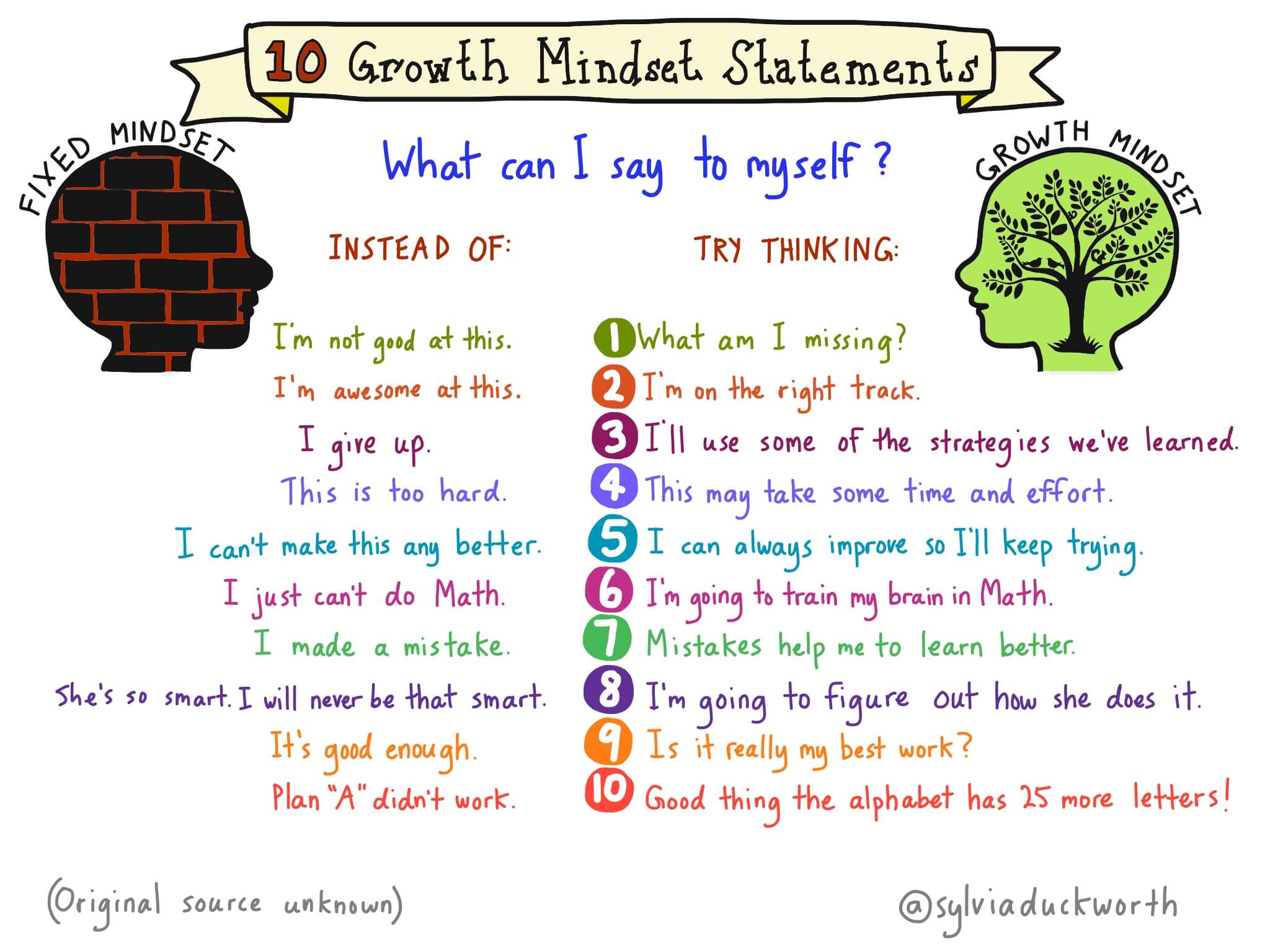
We as teachers should be mindful of the phrases we use in class to ensure that our students practice a growth mindset. Not only teachers, but students should also be aware of the different phrases they can subconsciously go through in their mind when faced with a challenge that inhibits them trying to solve the problem. Here is an image that can be projected to teach your students the different phrases to use.


Image result for deal with the cards you're dealt
Retrieved from Google Images: http://bit.ly/2w26wew
Coming back to the card-trick, eventually through a lot of collaboration we succeeded in figuring out the card trick. It showed us that through persistence, encouragement and perseverance, we eventually succeeded. We need to teach students to make the most of the current situation and help them with using strategies that will help them find success.

Thanks for reading this week's blog post, and I look forward to reading your comments!
- Nuha
Monday, September 11, 2017

Beyond Stereotypes

Welcome to my Math Blog!

There has been a lot of valuable information that was shared this past week in math class to demonstrate to future J/I division educators the importance of mindset. It started with an in class activity where the instructor showed us a card trick and really impressed us all. Then we were given the task to figure out the trick in groups of four. All the teacher candidates were focused and motivated to figure out the card trick. In our group, we were able to solve the trick by working through the problem backwards. There were two things learned through this demonstration; one is that children are naturally inquisitive, and if you pique their curiosity enough they will be engaged in the learning process. This requires teachers to know their students in order to create lesson plans that engage learners of all abilities.  The second was by collaborating in a group, we were able to figure the trick out. We helped each other out when figuring out the trick. It was nice to have a supportive group to sound out possible solutions and then figure out the problem through trial and error. This shows the power of collaboration and also teaches students how work together as a team to solve the problem.

The second half of the week was spent exploring various videos of breaking different stereotypes and how important it is to teach students to have an open mindset towards math. Being aware of such stereotypes as, “girls are not good in math,” helps educators become mindful and not fall prey to these stereotypes. In fact teachers can help break these stereotypes by creating activities that clear any misconceptions about math and steer students in the right direction. As future educators we set the tone in our classrooms, and it must be one that nurtures a positive attitude towards any obstacles the students face in class.  As Jo Boaler mentioned, our brains are like a muscle, the more we practice the more it grows!

The following video explores the idea of a growth mindset and may be useful in the junior division. The video can be used  as a strategy to teach students and to help them conceptualize the growth mindset.   Class Dojo has made a series of animated videos to help students understand the concept of the growth mindset. This can also help start the conversation, if certain students feel uncomfortable talking about their feelings and attitudes towards certain subjects such as math.  Another resource to introduce students to the idea of growth mindset is through storybooks such as, “Giraffes Can’t Dance”. It introduces to students the Power of Yet, teaching them that if they are having difficulty in something they may not understand it…. Yet! However by persisting, they will eventually get to the solution, and this works by training the brain to think positively.  This kind of attitude helps students look at things with a clear, open mind that will help ease their anxiety towards math.


(Retrieved from YouTube)

Thanks for reading,
-         Nuha

Sunday, December 11, 2016

Power of Yet

I did not know the importance of the growth mindset until the first day of classes, when all our classes addressed this concept. This is a powerful mindset to have, but in my opinion it takes time to get used to this type of thinking. This style of thinking is not only for teachers and educators to inculcate into their daily lives but to also teach children this powerful way of thinking. It requires one to re-wire their brain to always think with a positive lens, no matter what the outcome may be. It is to teach students to stay motivated despite their failures and to keep persevering until they get the answer. This is something I have observed being taught to the students daily; when they are frustrated and they feel like they want to give up, the teachers have taught them, “The Power of Yet.” Students are taught not to say, “I do not get it,” but rather, “I do not get it YET.” This teaches students not to give-up, that struggling is a way of learning and when they do get the answer they will remember it, compared to when they get the answer right away. It is also important to keep students motivated with not only the attitude they have towards math but also as they work through the math.

One way to keep students motivated through their work is to design the math problems in a way that intrigues young minds to keep working until they reach a solution. As educators it is our duty to provide students with multiple ways of representing their work. It is also important that math questions are designed to allow students at all levels get started working through the problem.  Here is a list of what makes a good math problem:

  • Relevant: It is important to pose question to students that they can relate to
  • Wide base: The problem is set-up and is doable by a wide range of learners
  •  Initial success: They offer initial success, motivating the learner to push beyond their limits
  • Low threshold and High ceiling: it has an opportunity for students of different levels of challenge to be able to tackle the problem, but also the potential for learners who like the extra challenge to extend the problem
  •  Engaging: The questions are set-up to engage the learner and draw them into solving the problem
  • More than one way: The problems have more than one way of arriving at the solution; thus sharing these different ways allows students to deepen and broaden their thinkin
Another aspect to consider when looking for a good mathematical problem is to think about the mathematical processes that will be taking place as the students work on the problems such as:

  •   Problem solving: Structured to include an inquiry problem where students have to investigated to figure out the solution, by making connections to previous concepts and making new discoveries.
  •   Connecting: previous experiences in problem solving help in my making new connections to new mathematical concepts
  • Reasoning and proving: As students develop new ideas and concepts they also develop reasoning and proving skills
  •  Representing: Students can represent work using concrete materials, pictures, diagrams, words and numbers
  •  Reflecting: Questions posed by peers and teachers are a good way of getting students reflecting on why they may have chosen a certain method to represent their solution, or why they think their solution works, etc.
  • Communicating: Students are able to prove their solution visually, orally or through writing
  • Selecting tools and computational strategies: Students are able to use a variety of tools and strategies to represent their answer
It was really important to know these seven mathematical process when observing students doing the problem-solving assignment. This was definitely my favourite assignment to observe students trying to solve math problems and how they used variety of mathematical process to find their solutions. One conclusion I would like to draw from the assignment is that the students I observed really took their time answering the questions. They also asked clarifying questions to make sure they were on the right track. I find that in the classroom sometimes there are students who may know the answer, but because they are too shy to ask, end up making mistakes on a test or assignment. As educators we must create a climate where students feel encouraged to ask questions to clear their doubts and fears and where enough time is allotted to deepen their mathematical concepts.

To conclude, this has been a very interesting class, I have learned a lot over the past twelve weeks and I continue to work on my growth mindset when working on creating my lesson plans. As I work to make them engaging and meaningful for the students at my placement. The work can get overwhelming at times, but having learned all the great techniques to make math subject students look forward to, and on way is the use of literature. I had the opportunity to use this technique and found that students were really captivated by the storytelling technique and I hope to use this and many other techniques learned in class this year!