Sunday, September 24, 2017

"Got Grit?"

This week's math class really got me reflecting on my own experiences as a student and how I handled failure and mistakes. I was not the best at dealing with mistakes, as it made me upset.  I felt that teachers should teach students that it is okay to make mistakes. In fact, there is scientific evidence to prove that mistakes actually help the brain grow and expand. Mistakes also help us to find new strategies when solving a problem and help us to become deep thinkers. Thinking back, going through those obstacles gave me a new perspective and allowed me to broaden my thinking as well as helped make new connections in life.  

Classroom Connection:
  1.         Teachers may have to explicitly teach students that mistakes are okay and students are encouraged to seek different solutions through reflecting on their mistakes.  
  2.         Educators can also implicitly teach this idea through the choice of words used to encourage students.
  3.         Teach students about individuals who used their mistakes to help them succeed.
  4.         Students can be taught about how to become a more successful individual such as:                      https://youtu.be/_GoYi3hfiBg
o   Taking risks
o   Being okay with mistakes
o   Being creative and playing with different ideas without making a quick judgement
o   Having an open mind to different experiences
o   Being open to trying new things that may go against the traditional ideas

Another mindset that students and teachers need to transform is the idea of the speed in which math problems are solved equates to the smartness of the child.  Speed sometimes is valued more than depth in thinking regarding a math problem. Teachers need to create math problems where students have the ability to exercise their mathematical reasoning by engaging with deep thoughts. Teachers also need to create an environment where students are not put-off by other students completing math problems faster than they can.

This leads me to introducing a TedTalk about Grit. Grit is the ability to persevere and show resilience towards any obstacle an individual may face in order to succeed. The talk by Angela Lee Duckworth mentions; that in order to practice Grit, one must be able to embrace the idea of a growth mindset.  
Retrieved from: https://youtu.be/H14bBuluwB8 


Thanks for reading this week's blog post, and I look forward to reading your comments!

- Nuha

Sunday, September 17, 2017

“You Play the Cards You’re Dealt”

In the first week when playing the card trick at the beginning of class we were able to figure out the math trick within the first few attempts. It felt good that we did not have to try as hard and were successful when finding the trick in the card game.  This week however there was a different emotion I felt, “frustrated!” No matter how many times we tried we could not figure out the trick. There were moments, even when an explanation was provided, I still felt, “lost.” Reflecting back on the process I learned a few lessons from that experience. First there are going to be students who may have similar emotions, and as an educator, I must have ways to help students cope with such emotions ready in my teacher toolbox. Another thing I learned was in that moment, I myself was undergoing a ‘fixed-mindset’. I realized that I must change my own way of thinking first, so that students don’t catch me in my moments of frustration when I face a challenge. Practicing a growth mindset from now will mean that I can effectively model to students how they can be successful when overcoming a challenge.

As educators we know how important the growth mindset is and there are a great number of resources available to teachers in order to implement it in our own classrooms. When looking resources on growth mindset, I came across the following website:


This resource made me aware of that fact that teachers should be sensitive to the phrases they use in their class such as simply telling a student to, “try harder,” can be a problem. Instead students should be taught why they need to continually put in the effort. Providing students with evidence about the plasticity of the brain can help them see the importance of continually putting in the effort. This website has embedded within it a lesson plan which highlights the following as it objectives for teaching students about the growth mindset:
  •           “Intelligence can be developed”
  •           “The brain is malleable”
  •          “Doing challenging work is the best way to make the brain stronger and smarter”

Image result for growth mindset
Retrieved from Google Images: http://bit.ly/2xIVU8P 

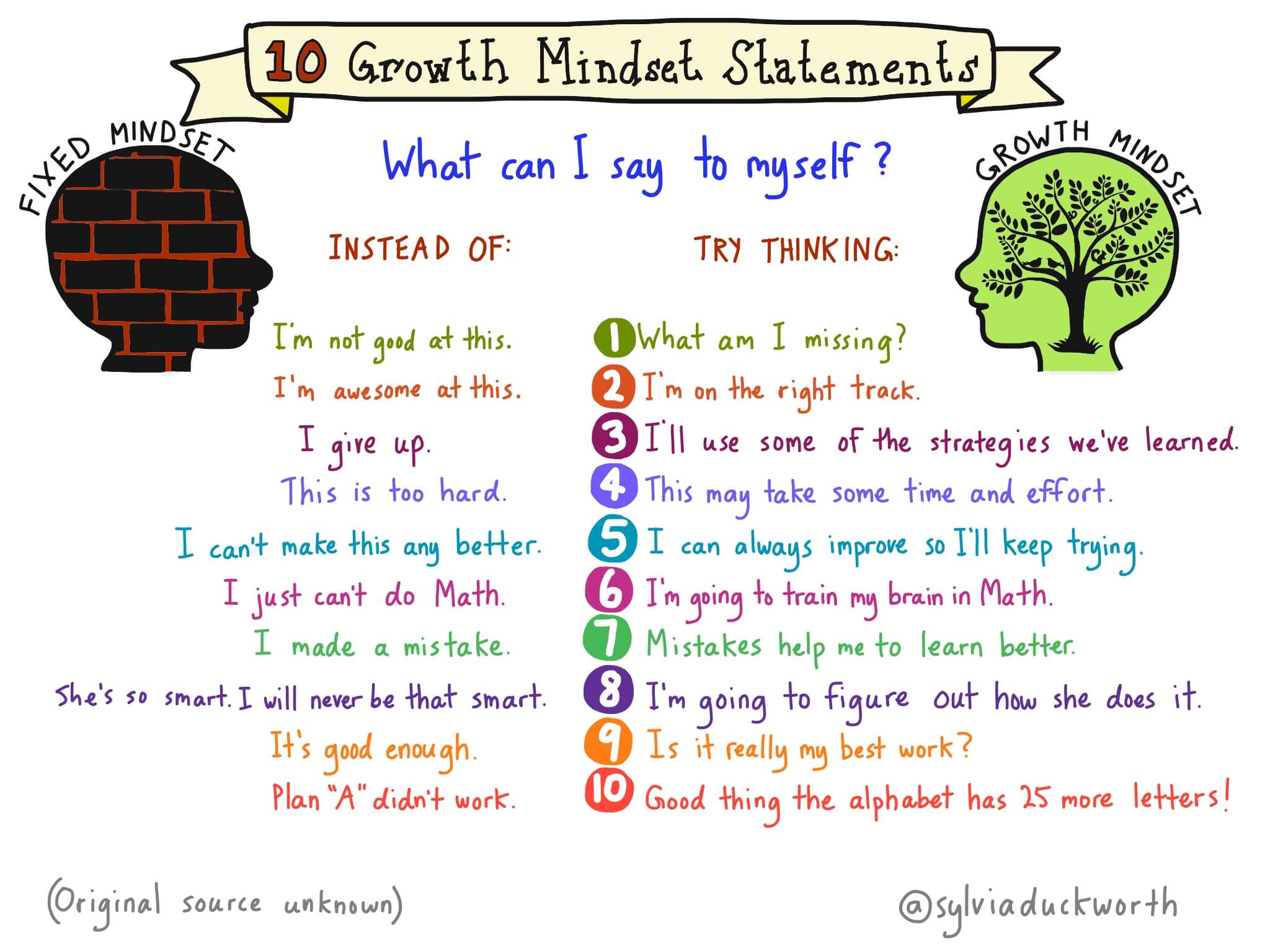
We as teachers should be mindful of the phrases we use in class to ensure that our students practice a growth mindset. Not only teachers, but students should also be aware of the different phrases they can subconsciously go through in their mind when faced with a challenge that inhibits them trying to solve the problem. Here is an image that can be projected to teach your students the different phrases to use.


Image result for deal with the cards you're dealt
Retrieved from Google Images: http://bit.ly/2w26wew
Coming back to the card-trick, eventually through a lot of collaboration we succeeded in figuring out the card trick. It showed us that through persistence, encouragement and perseverance, we eventually succeeded. We need to teach students to make the most of the current situation and help them with using strategies that will help them find success.

Thanks for reading this week's blog post, and I look forward to reading your comments!
- Nuha
Monday, September 11, 2017

Beyond Stereotypes

Welcome to my Math Blog!

There has been a lot of valuable information that was shared this past week in math class to demonstrate to future J/I division educators the importance of mindset. It started with an in class activity where the instructor showed us a card trick and really impressed us all. Then we were given the task to figure out the trick in groups of four. All the teacher candidates were focused and motivated to figure out the card trick. In our group, we were able to solve the trick by working through the problem backwards. There were two things learned through this demonstration; one is that children are naturally inquisitive, and if you pique their curiosity enough they will be engaged in the learning process. This requires teachers to know their students in order to create lesson plans that engage learners of all abilities.  The second was by collaborating in a group, we were able to figure the trick out. We helped each other out when figuring out the trick. It was nice to have a supportive group to sound out possible solutions and then figure out the problem through trial and error. This shows the power of collaboration and also teaches students how work together as a team to solve the problem.

The second half of the week was spent exploring various videos of breaking different stereotypes and how important it is to teach students to have an open mindset towards math. Being aware of such stereotypes as, “girls are not good in math,” helps educators become mindful and not fall prey to these stereotypes. In fact teachers can help break these stereotypes by creating activities that clear any misconceptions about math and steer students in the right direction. As future educators we set the tone in our classrooms, and it must be one that nurtures a positive attitude towards any obstacles the students face in class.  As Jo Boaler mentioned, our brains are like a muscle, the more we practice the more it grows!

The following video explores the idea of a growth mindset and may be useful in the junior division. The video can be used  as a strategy to teach students and to help them conceptualize the growth mindset.   Class Dojo has made a series of animated videos to help students understand the concept of the growth mindset. This can also help start the conversation, if certain students feel uncomfortable talking about their feelings and attitudes towards certain subjects such as math.  Another resource to introduce students to the idea of growth mindset is through storybooks such as, “Giraffes Can’t Dance”. It introduces to students the Power of Yet, teaching them that if they are having difficulty in something they may not understand it…. Yet! However by persisting, they will eventually get to the solution, and this works by training the brain to think positively.  This kind of attitude helps students look at things with a clear, open mind that will help ease their anxiety towards math.


(Retrieved from YouTube)

Thanks for reading,
-         Nuha